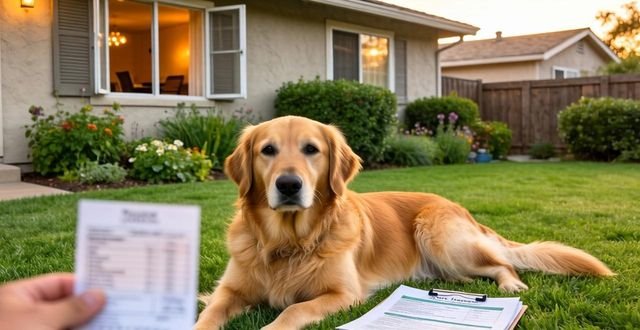
Pet Insurance in Chula Vista: Protect Your Pet, Protect Your Wallet
You’re standing in the checkout line at Petco on Broadway, holding a $70 bag of hydrolyzed protein kibble because your golden retriever suddenly developed allergies. Then your phone buzzes—it’s the vet’s office reminding you about the $1,800 dental cleaning your cat needs next week. And somewhere in the back of your mind, that nagging question surfaces: What if something real happens? A torn ACL. An eaten sock that won’t pass. A late-night emergency run to Veterinary Specialty Hospital on Bonita Road.
Here is where pet insurance stops being a “maybe” and starts being a math problem with serious emotional stakes.
Let me walk you through what I’ve learned after fifteen years selling insurance in Southern California—covering everything from condo master policies to exotic bird health plans. Pet insurance in Chula Vista isn’t like car insurance, where state law forces you to carry liability. Nobody’s making you buy it. That freedom is exactly why so many pet owners get burned.
How most people get it wrong
They look at the monthly premium—say, $45 for a three-year-old mixed breed with no pre-existing conditions—and think, “I’ll just save that money in a separate account.” Sounds reasonable, right? Except that account won’t have $8,000 in it next Tuesday when your dog breaks a canine playing fetch at Rohr Park. And here is the part the glossy brochures don’t shout: accidents don’t wait for your savings to mature.
The real trap is the “I have a healthy pet” assumption. Young pets have spectacularly bad judgment. They eat things that aren’t food. They jump off walls. They run into cactus patches. By the time your pet hits five or six and develops that suspicious limp, every insurance carrier will call it a pre-existing condition. Congratulations—you just saved $45 a month for four years, and now you’re paying 100% of that $5,200 TPLO surgery out of pocket.
How the carriers actually differ (and why you should care)
Let’s compare two policies you can buy today in Chula Vista, from carriers I’ll call Provider A and Provider B. Both offer unlimited annual coverage with 80% reimbursement after a deductible. On paper, they look identical. But read the fine print on Provider A: their “accident only” waiting period is 48 hours, but their “illness” waiting period is 14 days. Provider B flips that—5 days for accidents, 10 for illnesses. Why does that matter? Because if your puppy swallows a squeaker on a Saturday night, those extra 24 hours of waiting period could mean the difference between a $400 endoscopy and a $2,500 emergency abdominal surgery.
And then there’s the exam fee clause. Provider A counts the $85 office visit toward your deductible. Provider B excludes it entirely. Over three vet visits a year, that’s $255 you’re eating yourself. Doesn’t sound like much until you realize you could have bought a wellness rider with Provider A for $8 a month that covers those fees.
But here’s the catch that even some agents miss: reimbursement is always based on the vet’s submitted fee, not what you actually paid. If your vet in Eastlake charges $1,200 for an ultrasound,but Provider B’s “reasonable and customary” table says the same procedure should cost $900 in our ZIP code, you’re eating that $300 difference plus your 20% coinsurance. So your 80% coverage just became 75% in real terms. Ask your vet for their billing code, then call the carrier’s underwriting department and ask what that code reimburses at. If they hesitate, walk away.
The invisible tax nobody talks about
California doesn’t charge sales tax on pet insurance premiums. That’s the good news. The bad news? If you pay your premium through a flexible spending account or health savings account (and yes, some employers let you do this), the IRS considers that a qualified medical expense only if the pet is a service animal with documented disability-related work. For your emotional support corgi who helps with your anxiety? Not covered. Using pre-tax dollars for a standard pet policy triggers a taxable distribution, plus a 20% penalty if you’re under 65 and get audited. I’ve seen three clients hit with this. The letters from the IRS are not fun.
Three myths that keep Chula Vista pet owners vulnerable

Myth #1: “My homeowner’s insurance will cover vet bills if my dog bites someone.”
Wrong. Homeowner’s liability covers the person your dog bites. It doesn’t cover your dog’s rabies shot or wound cleaning. Separate policies for separate risks.
Myth #2: “I’ll just use CareCredit for emergencies.”
CareCredit is a great tool—if you pay it off in the promotional window. But deferred interest on a $3,000 balance at 26.99% APR that retroactively accrues? That’s how a single bladder stone surgery turns into a $4,700 nightmare. Insurance reimburses you. Credit cards just rearrange who you owe.
Myth #3: “My vet’s wellness plan is the same as insurance.”
Wellness plans cover vaccines, flea meds, and teeth cleanings—the predictable stuff. They don’t cover the unpredictable stuff. A wellness plan is a coupon book. Real insurance is a parachute. You don’t want to find out the difference while falling.
So what actually works for someone in Chula Vista right now?
Step one: Pull your pet’s medical records from the last two years. Every carrier will ask about pre-existing conditions, and the definition varies. Provider A considers anything that showed signs (not diagnosis) in the last 18 months as pre-existing. Provider B only cares about diagnosed conditions. If your vet wrote “possible early arthritis” in a note but never confirmed it, Provider A will exclude both hips. Provider B won’t. That’s a $7,000 difference if your dog needs bilateral FHO surgery later.
Step two: Choose your deductible based on your cash buffer. Most people pick the lowest deductible ($250) and highest monthly premium ($65). That’s backwards. You should pick the highest deductible you could comfortably pay out of savings ($1,000) and put the premium savings ($30/month instead of $65) into a separate pet emergency fund. Why? Because insurance is for the catastrophic—the $9,000 cancer treatment, not the $300 ear infection. Self-insure the small stuff. Transfer the big risk.
Step three: Look at providers that offer direct vet pay in our area. VCA, Banfield, and most independent clinics in Chula Vista will bill Trupanion directly. Others like Healthy Paws and Pets Best reimburse you after you pay. If your credit card has a $5,000 limit and the surgery is $6,200, direct pay means you don’t have to beg family for a bridge loan.
The bottom line that actually helps you decide
Ask yourself this: If your pet needed a $4,000 procedure tomorrow, could you write that check without missing a mortgage payment on your three-bedroom near Otay Ranch? If the answer is yes—genuinely yes, not “I’ll figure it out”—then skip insurance. Put $50 a month into a high-yield savings account and call it a day.
But if your stomach just tightened reading that number, you are exactly the person who needs a policy. Not because you expect your pet to get sick. Because you love them enough to admit that you are the one who can’t afford the worst-case scenario. And that’s not weakness. That’s just math with a heartbeat.
